What TEAS Questions Show About What You Don’tKnow

Most students think that the TEAS test is just a way to see how much information they can remember. In reality, TEAS questions are more like tests that help you figure out what’s wrong. Each question is meant to show how you think, where your understanding isn’t clear, and what learning gaps are holding you back. If you learn how to read TEAS questions correctly, they will tell you exactly what to fix, not just what is right or wrong.
TEAS questions are not memory tests; they are pattern detectors.
The TEAS test doesn’t often ask for facts on their own. Instead, the questions are designed to see if you can see patterns in science, math, reading, and English. A lot of the time, when a student has trouble, it’s not because they forgot a definition or formula; it’s because they can’t connect ideas.
In science, for instance, a question might require you to use your knowledge of basic anatomy and your ability to interpret data. If you know the organ system but read the chart wrong, the gap isn’t in the content; it’s in your analytical reading. TEAS questions are designed to show these weaknesses by being layered.
Repeated mistakes show where you need to learn more.
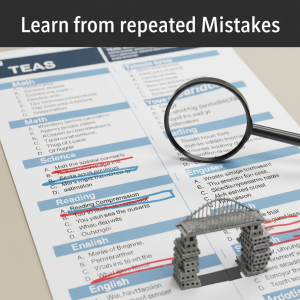
The TEAS test is trying to tell you something when you miss questions that are similar. Patterns in wrong answers are more important than the actual score.
- If you make the same math mistakes over and over, it might mean you don’t have a good sense of numbers or you don’t know how to estimate.
- Most of the time, science mistakes are caused by mixing up related ideas instead of not knowing anything at all.
- Errors in reading comprehension often show that it’s hard to figure out what the author meant or what the main idea was.
- English and language usage misses show that there are problems with grammar, not vocabulary.
- Every mistake you make is a clue. The test doesn’t just show you where you got the wrong answer; it also shows you where your foundation is weak.
The answer choices are meant to be like the mistakes you make when you think.
One of the most interesting things about TEAS questions is how the wrong answers are put together. Distractors aren’t random; they show common gaps in learning.
If you pick an option that looks “almost right,” it usually means:
- You get part of the idea, but not all of it.
- You depend on superficial acknowledgment rather than profound understanding.
- You hurry and think that what you know is right.
- This is how your wrong answer often shows more about what you don’t know than the right answer does.
Time Pressure Reveals Lack of Skills
A lot of students blame time for their low TEAS scores, but time pressure mostly shows weaknesses that were already there. When skills are good, speed comes naturally. When they aren’t, people are more likely to hesitate.
Running out of time in:
- Math shows that basic operations are not always clear.
- Reading indicates sluggish information processing.
- Science indicates inadequate integration of concepts.
TEAS questions show you which skills you still need to work on.
Students who do well use questions as feedback.
The best TEAS test takers don’t just answer questions; they also look at them. Every question you miss is feedback, not a failure. They want to know:
- Why did this choice seem right?
- What idea did I not understand?
- What kind of mistake is this?
- This method makes the test a learning map that helps you plan your future studies instead of making them too hard.
Making a Study Plan from TEAS Questions
The best way to get ready isn’t to study everything again, but to let TEAS-style questions guide your attention. Keep track of your mistakes, sort them by type, and learn the skills behind the topics, not just the topics themselves.
When you do this, TEAS questions don’t scare you anymore. They become signs that show you exactly what you need to learn and how to do it quickly.
TEAS questions don’t just check if you’re ready; they also find out if you are. You get a huge advantage if you pay attention to what they say: targeted preparation that turns weaknesses into strengths.
For more information or inquiry reach out through:
EMAIL;support@virtualclassroompro.org OR via
TEL;+19367581107
